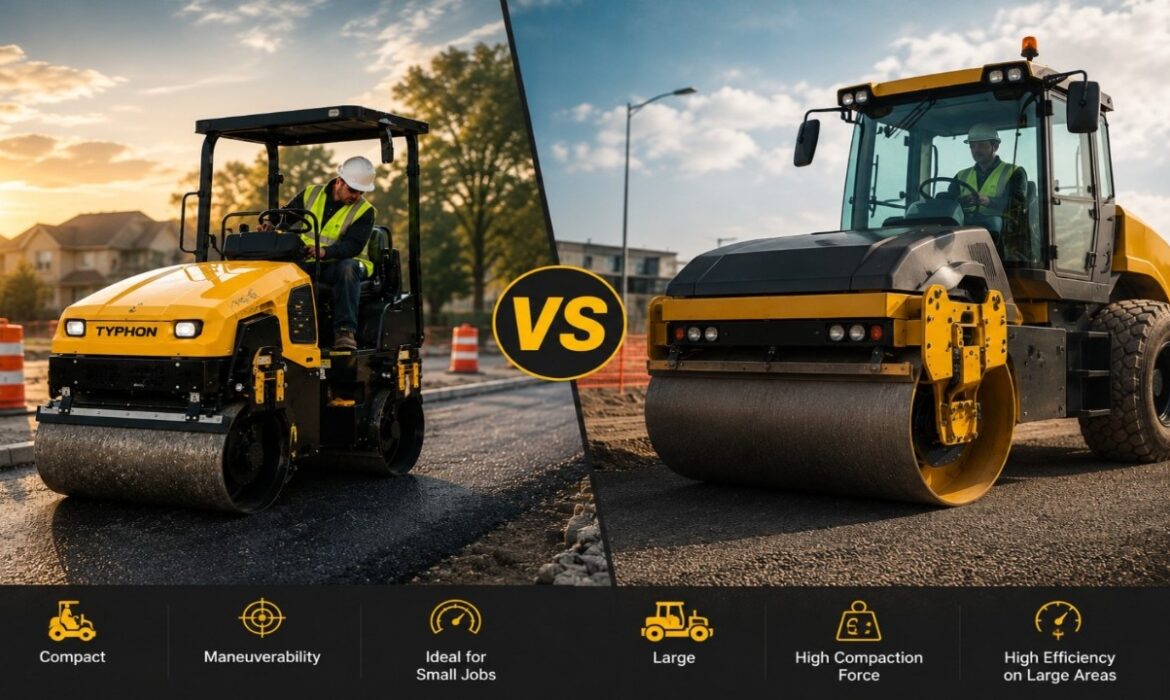
Compact vs Large Vibratory Rollers: 10 Critical Key Differences You Must Know
You walk onto a rental lot. You see two rollers. One small. One large. Both compact ground. Both vibrate. Which one do you take?
You need the right answer. Pick the wrong size. You waste money. You slow down your crew. You damage the work site.
Here are the key differences between compact rollers and Large Vibratory Rollers. You must know these before you rent or buy.
☰ Table of Contents
Operating Weight Changes: What You Can Compact
Compact rollers weigh between 1 and 4 tons. Large Vibratory Rollers weigh between 8 and 15 tons.
Weight determines soil depth. A compact roller compacts lift depths up to 8 inches. Large Vibratory Rollers compact lift depths up to 20 inches.
You cannot swap one for the other. Put a compact roller on a 15-inch lift. The bottom half stays loose. The ground settles next year. Put Large Vibratory Rollers on a 4 inch lift. You crush aggregate. You turn stone to dust.
Example: A residential driveway needs a 6 inch base. Use a compact roller. A highway subbase needs a 15 inch lift. Use Large Vibratory Rollers.
Drum Width Changes Your Coverage Per Pass
Compact rollers have drums between 20 and 40 inches wide. Large Vibratory Rollers have drums between 50 and 84 inches wide.
Wider drums cover more ground per pass. A 60-inch drum covers three times the area of a 20-inch drum per pass.
But wider drums do not fit everywhere. A 60-inch drum does not fit between two houses. A 60-inch drum does not fit inside a trench. A 20-inch drum fits through a 24-inch gate.
You choose based on your job site. Open parking lot. Use Large Vibratory Rollers. Backyard patio. Use a compact roller.
Exciting Force Determines Compaction Energy
Exciting force is the vibration power. It measures in kilonewtons or KN.
Compact rollers deliver 20 to 40 KN of force. Large Vibratory Rollers deliver 80 to 200 KN of force.
More force means deeper compaction. But more force also means more risk. Too much force on a thin lift destroys the material. Too much force on a pipe crushes it. Too much force on a finished surface leaves cracks.
A compact roller at 25 KN works perfectly on a 6 inch gravel driveway base. Large Vibratory Rollers at 120 KN on that same base fracture the individual stones. You create a weak layer instead of a strong one.
Maneuverability Changes How You Turn
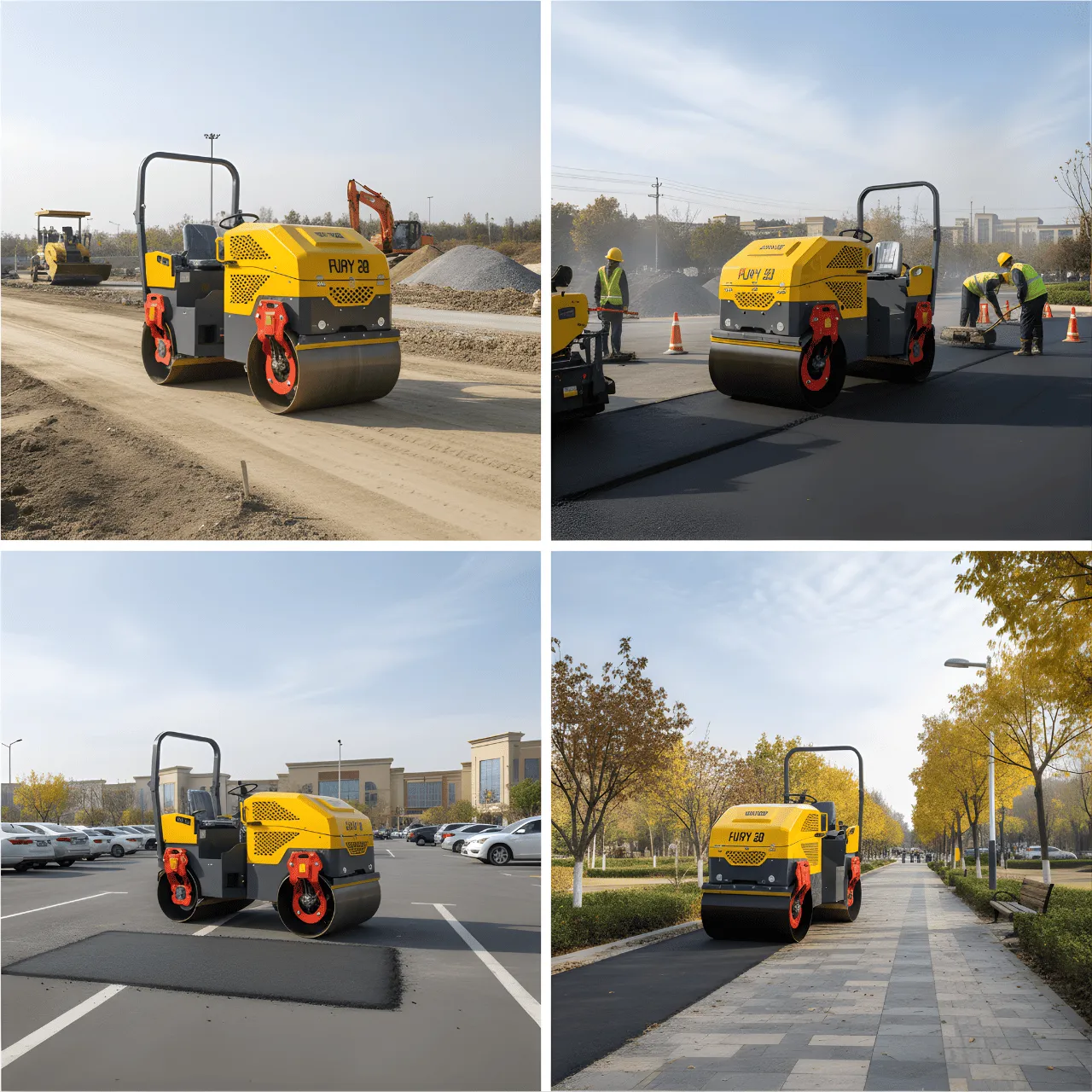
Compact rollers have a tight turning radius. Some models turn within 5 feet. You turn around in a residential driveway. You navigate around trees and light poles.
Large Vibratory Rollers need space. A 10-ton roller requires 15 to 20 feet to turn around. You cannot use one in a cul-de-sac. You cannot use one in an alley.
A contractor in Chicago repairs alleyways. He uses a compact roller. He turns the machine in the alley. He does not back out into traffic. Large Vibratory Rollers would get stuck. He would block the entire street.
Transportation Requirements Change Your Logistics
You need to move your roller between job sites. A compact roller fits on a single-axle trailer. You pull it with a half-ton pickup truck. You do not need a special license. You do not need a DOT number.
Large Vibratory Rollers require a lowboy trailer. You need a heavy-duty truck to pull it. You need a commercial driver’s license or CDL in most states. You need to stop at weigh stations. You need special insurance.
The math changes your cost per job. A compact roller costs 20 dollars in fuel to move across town. Large Vibratory Rollers cost 150 dollars in fuel, plus driver time, plus permits. You only move Large Vibratory Rollers for jobs that last one week or longer.
Vibration Frequency Ranges Change Surface Finish
Vibration frequency measures in hertz or Hz. Frequency controls how smooth or rough the finish looks.
Compact rollers offer variable frequency from 40 to 70 Hz. You run low frequency at 40 Hz for thick base rock. You run at a high frequency at 70 Hz for asphalt finish passes.
Large Vibratory Rollers offer lower frequency ranges from 25 to 50 Hz. The lower frequency moves more material per impact. This works for deep lifts. It leaves a rougher surface.
For a finished asphalt driveway, you want smooth. Use a compact roller at high frequency. For a road subbase that gets covered, use Large Vibratory Rollers at low frequency.
Drum Type Changes Your Applications
Compact rollers come in a smooth drum configuration. Smooth drums work on asphalt, gravel, and soil. You cannot compact cohesive clay with a smooth drum. The clay sticks.
Large Vibratory Rollers offer multiple drum options. Padfoot drums for clay. Smooth drums for asphalt. Combination drums for transition zones.
If you work on clay soils, you need Large Vibratory Rollers with padfoot drums. A compact smooth drum roller will not compact clay effectively. The clay clogs the drum. You get zero density gain after three passes.
Operator Position Changes Visibility
Compact rollers offer standing or walking operator positions. You stand on a platform. You walk behind the machine. You see the drum edge directly. You see exactly where you compact.
Large Vibratory Rollers have enclosed cabs. You sit inside. You look through windows. You lose visibility of the drum edge. You rely on mirrors and cameras.
For precision work near curbs and walls, a compact roller gives better visibility. You place the drum within one inch of a vertical surface. Large Vibratory Rollers leave a 6 inch gap. You hand tamp that gap.
Purchase Price Changes Your Entry Point
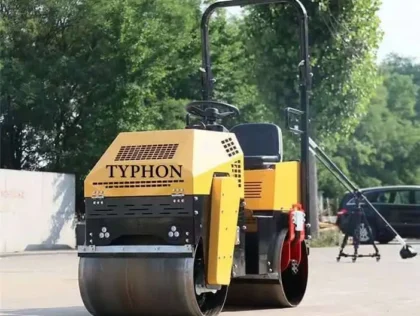
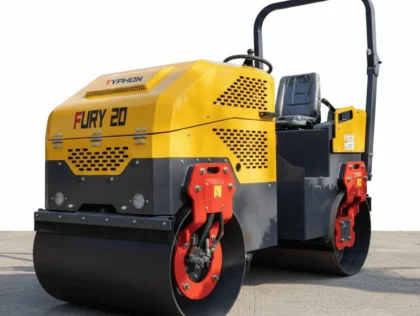
Compact rollers cost between 8,000 and 25,000 dollars new. You buy a TYPHON 1 ton roller for 8,817 dollars. You start working tomorrow.
Large Vibratory Rollers cost between 80,000 and 200,000 dollars new. You finance the machine over 5 years. You need steady work to cover the payments.
You do not buy Large Vibratory Rollers for sporadic work. You rent one for the two weeks you need it. You buy a compact roller for the 200 days a year you use it.
Maintenance Complexity Changes Your Downtime
Compact rollers use simple systems. Air-cooled gasoline engines. Basic hydraulic pumps. Single drum bearings. You fix most problems with hand tools. You buy parts from any small engine dealer.
Large Vibratory Rollers use complex systems. Water-cooled diesel engines with emissions controls. Multi-circuit hydraulics. Electronic vibration controls. You need a dealer technician for most repairs. You wait days or weeks for parts.
A blown hydraulic hose on a compact roller costs 40 dollars and 1 hour of your time. The same failure on Large Vibratory Rollers costs 400 dollars and a service call fee of 500 dollars. You lose two days of work.
How to Choose Between Compact and Large
Ask yourself four questions.
- First, what lift depth do you compact? Under 8 inches, choose compact. Over 8 inches, choose large.
- Second, what is your smallest access point? Under 40 inches wide, choose compact. Over 50 inches wide, choose large.
- Third, how often do you move the machine? Daily moves, choose compact. Weekly moves, choose large.
- Fourth, what is your budget? Under 25,000 dollars, choose compact. Over 80,000 dollars, choose large.
One Contractor’s Decision
A site contractor in Arizona buys his own equipment. He owns one heavy roller for highway subbase work. He rents it out to other contractors when he does not use it. He owns two compact rollers for residential driveways and commercial parking lots.
The Reality of ROI
He told me the compact rollers pay for themselves in 8 months. The heavy roller took 3 years to pay off. He uses the compact rollers 4 days per week. He uses the heavy roller 2 days per month. He uses each for the right job and never wastes a heavy roller on small work.
Your Next Step: Look at your next five jobs. Measure the lift depth. Measure the access width. Count how many times you move the machine. Total your budget.
Looking for reliable, top-tier compaction equipment for your next big project? Find the right size and power for your exact job site needs.
View Equipment & Buy Now