
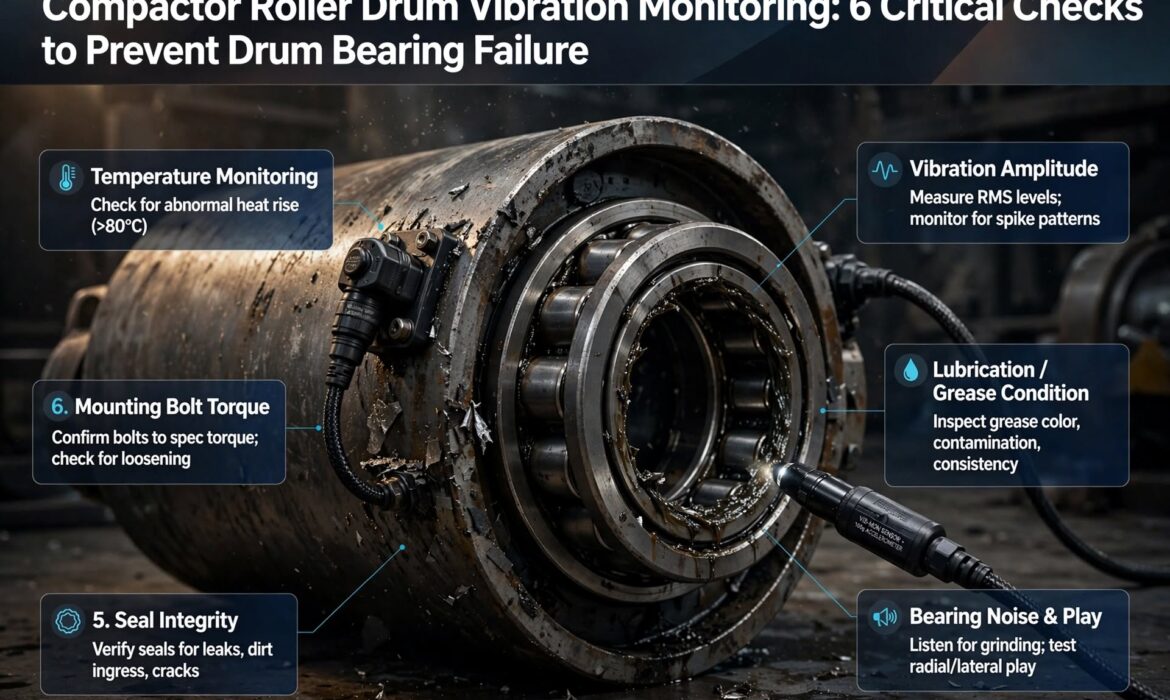
Compactor Roller Drum Vibration Monitoring is not a complicated task. It is a simple routine. It takes minutes. It saves thousands. Drum bearings fail without warning. Or so it seems. In truth, the warning signs appear weeks before failure. Compactor Roller Drum Vibration Monitoring catches those signs. It gives time to plan a repair. It prevents a sudden breakdown on the jobsite.
A failed drum bearing stops the roller. It damages the drum. It damages the shaft. The repair bill climbs fast. A new bearing costs a few hundred dollars. A new drum costs thousands. A new shaft adds more. Downtime costs even more. A crew stands idle. A client waits. A deadline slips.
If you prioritize compactor roller walkaround safety, you must also prioritize this. This guide covers 6 critical checks. Each check focuses on Compactor Roller Drum Vibration Monitoring. Each check takes minutes. Each check prevents a failure.
☰ Table of Contents
- 1. Baseline Vibration Measurement
- 2. Daily Vibration Check by Feel
- 3. Weekly Vibration Meter Reading
- 4. Bearing Temperature Check
- 5. Lubrication Check
- 6. Visual Inspection of Drum and Shaft
- The Cost of Ignoring Vibration
- Vibration Monitoring Schedules
- Common Monitoring Mistakes
- Real Contractor Experiences
- Training on Vibration Monitoring
Baseline Vibration Measurement
Every drum has a normal vibration pattern. This pattern is the baseline. A baseline is recorded when the drum is new or freshly repaired. The baseline shows how the drum should feel and sound.
Record the baseline vibration. Use a vibration meter. Mount the sensor on the drum bearing housing. Run the roller at operating speed. Record the vibration level. Note the frequency. Note the amplitude. Store the baseline reading. Write it in the maintenance log. Save it on a phone. Keep it safe. This reading becomes the reference point for all future checks.
Compare every future reading to the baseline. A small change means something is shifting. A large change means something is wrong. Catch the change early. Fix the problem before failure. A contractor in Texas records baseline vibration on every new roller. He compares readings every month. He caught a bearing problem at 400 hours. The repair cost $300. A failure would have cost $3,000. Compactor Roller Drum Vibration Monitoring starts with a baseline. Without a baseline, changes are invisible.
Daily Vibration Check by Feel
Not every check needs a meter. The hands can feel vibration changes. The feet can feel vibration changes. The ears can hear vibration changes. Touch the drum bearing housing after a short run. Feel the vibration level. Compare it to normal. A new vibration means something changed.
Touch the drum surface. Feel for unusual pulsing. Feel for grinding. Feel for roughness. A smooth drum feels smooth. A failing drum feels rough. Listen to the drum while rolling. Normal sound is steady. A failing bearing makes noise. It whines. It grinds. It clicks. The noise changes with speed.
A contractor in Florida checks vibration by feel every morning. He said his hands know the machine better than any meter. He caught a bearing problem before it failed. Compactor Roller Drum Vibration Monitoring by feel is free. It takes seconds. It works and is a core part of Compactor Roller Drum Vibration Monitoring.
Weekly Vibration Meter Reading
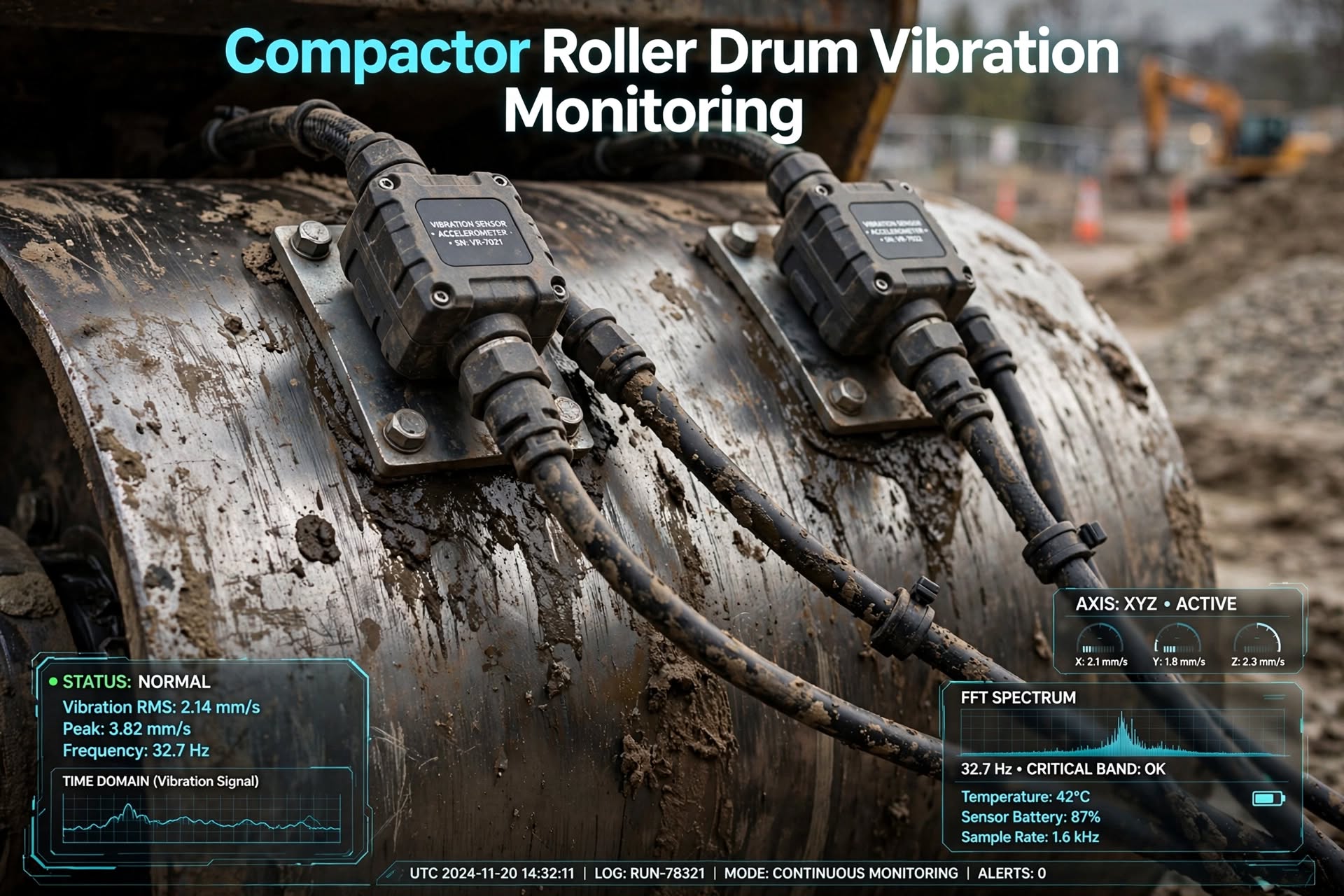
A vibration meter gives precise numbers. It shows changes the hands might miss. It records data for comparison. It provides proof of condition. Take a vibration meter reading every week. Mount the sensor on the same spot every time. Run the roller at the same speed. Record the reading.
Compare the weekly reading to the baseline. A 10 percent increase means watch closely. A 25 percent increase means schedule a repair. A 50 percent increase means stop operating. Check the vibration frequency. Different frequencies point to different problems. A low frequency points to imbalance. A high frequency points to bearing wear. A varying frequency points to looseness.
A contractor in California takes weekly readings. He plots the numbers on a chart. He sees trends before they become failures. His repair costs dropped 40 percent. Compactor Roller Drum Vibration Monitoring with a meter provides hard data. Compactor Roller Drum Vibration Monitoring data supports decisions.
Bearing Temperature Check
Vibration and heat go together. A failing bearing generates heat. The heat shows up before the vibration becomes severe. Temperature checks catch problems early. Touch the bearing housing after a short run. It should be warm. It should not be hot. A hot housing means trouble.
Use an infrared thermometer for precise readings. Point it at the bearing housing. Record the temperature. Normal temperature is 100 to 140 degrees Fahrenheit. Higher temperatures mean friction. Friction means wear. Compare temperatures between bearings. One bearing hotter than the other means a problem. The hot bearing is failing.
Check temperature daily. Check temperature after heavy use. Check temperature in hot weather. Heat accelerates failure. A contractor in Arizona checks bearing temperature every morning. He found one bearing running 30 degrees hotter than the others. He replaced it. The cost was $200. A failure would have cost $2,500. Compactor Roller Drum Vibration Monitoring includes temperature. Heat is a vibration symptom.
Lubrication Check
Bearings need grease. Grease reduces friction. Grease carries away heat. Grease prevents wear. Wrong grease or missing grease causes vibration. Vibration causes failure. Check grease fittings before every shift. Look for damage. Look for missing fittings. Look for blocked fittings.
Grease the bearings at the recommended interval. Use the correct grease type. Check the manual. Do not guess. Do not over grease. Too much grease blows seals. Blown seals let dirt in. Dirt causes wear. Wear causes vibration. Do not under grease. Too little grease causes metal contact. Metal contact causes vibration. Vibration causes failure.
A contractor in Ohio greases his drum bearings every 50 hours. He uses the correct grease. He has not replaced a bearing in 4 years. Compactor Roller Drum Vibration Monitoring includes lubrication. Excellent Compactor Roller Drum Vibration Monitoring starts with grease as the first line of defense.
Visual Inspection of Drum and Shaft
Vibration has physical causes. Loose bolts. Cracked welds. Worn shafts. Damaged drums. Visual inspection catches these causes. Inspect the drum before every shift. Look for cracks. Look for dents. Look for wear. Look for missing bolts.
Inspect the shaft. Look for wear. Look for scoring. Look for bending. A bent shaft causes vibration. A worn shaft causes vibration. Inspect the bearing housing. Look for cracks. Look for leaks. Look for loose bolts. Tighten loose bolts. Replace cracked housings.
Inspect the drum scrapers. Worn scrapers cause uneven contact. Uneven contact causes vibration. Replace worn scrapers. A contractor in Texas found a loose bearing housing bolt during a visual check. He tightened it. The vibration stopped. The cost was zero. A failure would have cost $2,000. Compactor Roller Drum Vibration Monitoring includes visual checks. Eyes catch what meters miss.
The Cost of Ignoring Vibration
A failed drum bearing stops the job. The roller cannot compact. The crew waits. The client calls. The deadline slips. Repair costs add up. A new bearing costs $200 to $500. A new shaft costs $800 to $1,500. A new drum costs $3,000 to $6,000. Labor adds more.
Downtime costs more. A crew costs $500 to $1,500 per day. Equipment rental costs $200 to $400 per day. Lost revenue costs thousands. Skipping Compactor Roller Drum Vibration Monitoring creates huge financial risk. A Compactor Roller Drum Vibration Monitoring routine costs minutes per day. It prevents these costs. The math is clear.
Vibration Monitoring Schedules
To master Compactor Roller Drum Vibration Monitoring, follow these schedules:
Daily Compactor Roller Drum Vibration Monitoring Schedule
Before every shift: Check vibration by feel. Check bearing temperature by touch. Check grease fittings. Inspect drum and shaft visually. This takes 5 minutes. It catches most problems early.
Weekly Compactor Roller Drum Vibration Monitoring Schedule
Every week: Take vibration meter readings. Record bearing temperatures. Compare readings to baseline. Check grease condition. This takes 15 minutes. It catches trends before failure.
Monthly & Annual Schedule
Monthly: Analyze vibration data. Check bearing clearance. Inspect shaft for wear. Review maintenance log. This takes 30 minutes. Annual: Professional vibration analysis. Bearing replacement if needed. Shaft inspection and repair. Drum inspection and repair. This takes 1 day. It prevents major failures.
Common Monitoring Mistakes
Poor Compactor Roller Drum Vibration Monitoring habits lead to failure. Skipping the baseline. Without a baseline, changes are invisible. Record the baseline on day one. Using the wrong meter. Different meters give different readings. Use the same meter every time.
Measuring at different spots. Different spots give different readings. Mark the spot. Measure the same spot every time. Ignoring small changes. Small changes grow into big problems. Watch every change. Waiting for noise. Noise means advanced wear. Implement Compactor Roller Drum Vibration Monitoring before noise starts.
Real Contractor Experiences
A contractor in Texas focuses on Compactor Roller Drum Vibration Monitoring on 5 rollers. He records data weekly. He caught 3 bearing problems before failure. He saved $7,000 in repairs and downtime.
A contractor in Florida ignored vibration. His drum bearing seized at 600 hours. The shaft was damaged. The repair cost $4,000. He now relies on Compactor Roller Drum Vibration Monitoring daily. A contractor in California uses a phone app for vibration data. He said the app makes monitoring easy. He has not had a bearing failure in 3 years.
Training on Vibration Monitoring
Train every operator on Compactor Roller Drum Vibration Monitoring. Show them how to feel vibration. Show them how to use the meter. Show them how to record data. Show them how to compare readings.
Make monitoring part of the daily routine. No machine moves until Compactor Roller Drum Vibration Monitoring is done. Supervisors should spot check. Praise operators who follow the routine. A contractor in Ohio trains every new operator on vibration monitoring. He said the training takes 1 hour. The savings last years.
Stop paying thousands for unpredicted drum and shaft failures. Secure a reliable machine that is easy to monitor, maintain, and service directly on the jobsite.
View the TYPHON Fury 1.5 Ton Roller